Zerqonixan
Cloud Session
Cloud Session
Couldn't load pickup availability
- 📥 Digital file available after purchase
- 🗂️ Long-term availability
- 🔒 Secure checkout
- 📅 Content updated in 2026
Self-paced learning overview
Problem Statement
Large API environments may include many routes, user roles, connected workflows, data categories, and change cycles. Reviewing each element separately can leave gaps between teams, documents, and technical processes.
Learners may understand individual areas such as authentication, permissions, validation, activity records, and change review, but still find it difficult to combine them into one coordinated assessment. Findings may be recorded in different formats, ownership may remain unclear, and related concerns may be treated as isolated observations.
Solution
This course introduces a system-wide method for planning, conducting, documenting, and revisiting API security assessments. Learners examine how routes, identities, permissions, inputs, responses, activity records, and technical changes interact across a broader environment.
The modules guide learners through defining review scope, dividing responsibilities, mapping connected components, organizing findings, and preparing follow-up actions. Scenario-based activities help learners combine several review methods into one structured workflow.
What’s Inside
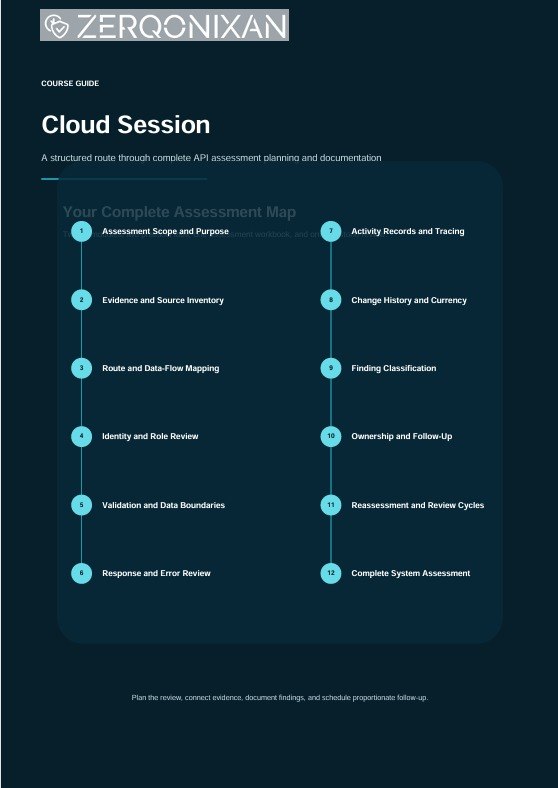
The course includes modules on assessment planning, scope definition, route inventories, data-flow maps, permission analysis, validation reviews, event tracing, change comparisons, finding classification, review ownership, and follow-up documentation.
Learners will complete a detailed scenario involving several roles, connected routes, shared records, workflow changes, and activity events. Supporting materials include planning tables, assessment worksheets, reporting structures, review checklists, and course summaries.
Who Is This For?
The Cloud Session is intended for learners who already understand endpoint mapping, permission review, validation, connected workflows, activity tracing, and API change analysis.
It may be useful for developers, testing learners, technical reviewers, documentation specialists, project coordinators, and people involved in broader API review planning.
What You’ll Learn
- Define the scope of a complete API security assessment
- Map routes, roles, data, and connected workflows
- Coordinate several review methods within one process
- Assign clear responsibilities for assessment tasks
- Compare controls across related API areas
- Organize findings by category and relevance
- Connect permission, validation, and data observations
- Include activity records and change history in reviews
- Review whether earlier findings were addressed
- Complete a system-wide API assessment scenario
Guarantee
The Cloud Session includes a 30-day money-back policy. Learners may request a refund within 30 days of purchase according to the published refund conditions.
This provides a risk-free period for reviewing the course structure and deciding whether the materials suit their learning needs.
Certification
The course includes a certificate of completion, giving learners a clear way to confirm their progress and present their completed learning milestone.
Share
Do I need prior API security knowledge?
Do I need prior API security knowledge?
No. Each tier follows a structured learning path and explains its topics with clear terminology, practical examples, and guided exercises. Learners can begin with foundational material and move toward more detailed security concepts over time.
How are the tiers different?
How are the tiers different?
The tiers are arranged in ascending order. Earlier tiers introduce core ideas and basic review habits, while later tiers examine broader security planning, testing methods, documentation, and multi-stage API scenarios.
How are the course materials organized?
How are the course materials organized?
Each tier is divided into focused modules. The materials may include explanations, scenario reviews, checklists, exercises, knowledge summaries, and practical tasks designed to connect individual concepts.